Couples Yoga: 10 Partner Yoga Poses for Beginners
Couples yoga is for two people who want to do something together that is not dinner, a screen, or an argument about dinner. You do not need to be flexible, you do not need matching outfits, and neither of you needs a single yoga class behind you. This guide gives you the consent and safety cues that make partner yoga feel good instead of awkward, ten beginner partner yoga poses with step-by-step instructions, a 20-minute flow that links them, and honest fixes for when one of you is taller, stiffer, or more experienced than the other.
Why partner yoga is worth trying
I teach yoga and I train couples, and for a long time I kept those two things separate. The full-body couples workout I wrote years ago is all plank high fives and medball passes: loud, sweaty, competitive in a fun way. Partner yoga is the opposite end of the same idea. Same two people, same trust, but now the goal is to slow down and pay attention to each other.
Three things make it worth your time.
Trust, because several of these poses only work if you actually lean on the other person. Supported chair and double tree fall apart the second one of you hedges.
Communication, because you have to say “more,” “less,” and “stop” out loud and mean it. Couples who struggle to ask for what they need in a seated forward fold usually struggle to ask for it elsewhere too, and the mat is a very low-stakes place to practice.
Fun, because you will wobble, fall out of double tree, and laugh. If you take your yoga very seriously, this is a healthy antidote.
If one of you has never done yoga, I would still start here rather than waiting. The poses below are built from the same foundations as my 4-week beginner yoga plan for home, and learning them with a partner is a gentler introduction than a class full of strangers.
Consent and safety cues before you start
Partner yoga has one rule that matters more than any alignment cue: nobody moves another person’s body without being asked. Here is how I set couples up in the first five minutes.
- Agree on three words: “more,” “ease off,” and “stop.” “Stop” is immediate and never debated.
- The person being supported sets the depth. The supporter adds only what is asked for.
- Check in at every pose, out loud. “How’s that?” is enough. Silence is not a yes.
- No bouncing, pulling, or surprise pressure. Everything is slow and announced.
- Keep weight off joints. Supporters lean into muscle (the back, the thighs, the hips), never onto knees, the spine itself, or the neck.
- Come out of a pose the way you went in, together and slowly. Most partner yoga wobbles happen on the way out.
- Clear the space. Two mats side by side on a non-slip floor, with nothing nearby to hit if you tip over.
One sentence for the record: if either of you is pregnant, has a recent injury, or has back, knee, or shoulder issues, ask a doctor or physical therapist before trying these, and skip any pose that creates sharp or familiar pain.
The ten partner yoga poses
These are in the order I teach them. The first few build the habit of breathing and talking together; the later ones ask for more trust. Hold times are suggestions. Stay only as long as you both feel steady.
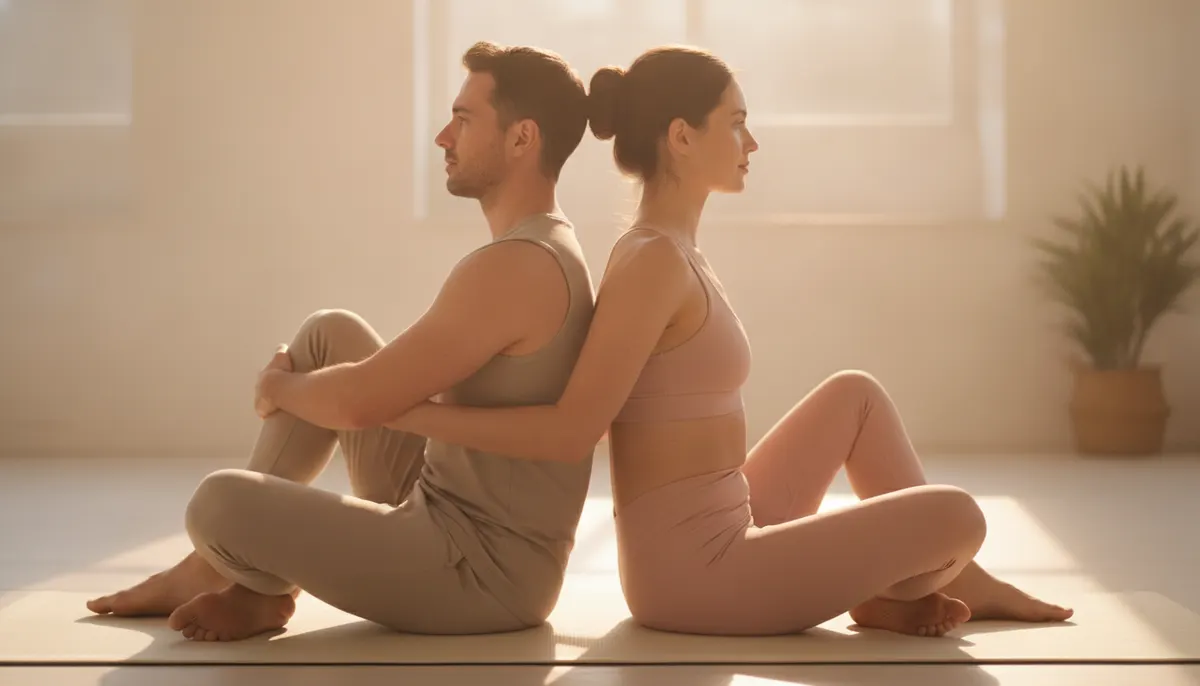
1. Seated back-to-back breathing
Sit cross-legged, back to back, spines tall and touching from the hips to the shoulder blades. Rest your hands on your knees. Close your eyes and breathe slowly through your nose, feeling your partner’s back expand against yours. After a few breaths, try to match: in together for a count of four, out together for a count of six.
Stay for two to three minutes. This is the pose to come back to whenever anything else gets wobbly or tense, and the longer exhale is the same calming breath I teach in my yoga for stress and anxiety sequence.
2. Back-to-back twist
From the same seat, both of you inhale and sit tall. On the exhale, both twist to the right: your right hand reaches back to rest on your partner’s left knee or thigh, and your left hand rests on your own right knee. Keep pressing gently into each other’s backs so neither of you slumps.
Hold for five slow breaths, then inhale back to center and twist left. The support of your partner’s back is what lets you twist without collapsing, which is why this feels better than a solo twist.
3. Double tree
Stand side by side, hips about a foot apart, and wrap your inside arms around each other’s waists. Each of you shifts weight onto the inside leg, then lifts the outside foot and places it against the inside ankle, calf, or inner thigh (never against the knee). Press your outside palms together in front of you, or raise them overhead.
Pick a spot on the wall to look at and breathe for five to eight breaths. Then turn around so the other leg is on the inside and repeat. Wobbling is part of the pose; so is grabbing your partner tighter.
4. Partner seated forward fold
Sit facing each other with your legs straight and wide, the soles of your feet touching (or your ankles, or your shins, depending on leg length). Hold each other’s hands or forearms.
Partner A leans back slowly, gently drawing Partner B forward from the hips while B keeps their chest lifted and spine long. Hold for five breaths, then reverse. The person folding sets the depth with “more” or “ease off.” Two rounds each.
5. Double downward dog
Partner A comes into downward dog: hands shoulder width apart, hips lifted high, heels reaching toward the floor. Partner B stands just in front of A’s hands, facing away from A, and places their own hands on the floor a couple of feet further forward. B then lifts one foot at a time back onto A’s lower back, close to the hips, and presses up into their own downward dog.
This looks dramatic and is easier than it sounds, but it has rules. B’s feet go on the broad, muscular part of A’s lower back, never on the spine, and B keeps most of their weight in their own hands. Hold for five breaths, then B steps down one foot at a time. Switch only if the sizes work; a much heavier partner should be the base, not the top.
6. Seated cat-cow facing
Sit cross-legged facing each other, knees close, holding each other’s forearms. Inhale together and arch: lift your chests, draw your shoulder blades together, let your gaze lift, and lean back gently against the hold of your partner’s arms. Exhale together and round: tuck your chins, pull your navels in, and let your upper backs curve.
Flow between the two shapes for eight to ten breaths. The gentle traction of leaning back against each other opens the chest more than a solo cat-cow ever does.
7. Partner boat
Sit facing each other with your knees bent and your feet flat, close enough to hold hands on the outside of your legs. Lift your feet and press the soles of your feet against your partner’s, knees bent. Keep holding hands and sit up tall, chests lifted.
If that feels steady, slowly straighten your legs together so your feet rise toward the ceiling and your bodies make a wide V. Hold for five breaths, then bend the knees and lower. It is fine to stay with bent knees; the core work is the same.
8. Supported chair
Stand back to back with your feet hip width apart, backs touching. Walk your feet forward a half step. Pressing into each other’s backs, slowly bend your knees and slide down together until your thighs are roughly parallel to the floor, as if sitting in a chair with your partner as the backrest.
Hold for five to ten breaths, then press and rise together. Talk the whole way down and up: “going down,” “hold,” “coming up.” If you have ever tried a back-to-back partner squat, this is the yoga cousin, and I use the same cues for both.
9. Partner warrior
Stand back to back. Each of you steps your right foot forward about a leg’s length and turns your left foot out, so your back feet end up side by side and touching along the outer edges. Bend your right knee until it stacks over the ankle, and reach both arms out to shoulder height. Your back hands will meet behind you; hold them.
Breathe for five breaths, keeping your torso upright over your hips instead of leaning toward the front leg. The joined hands give you a gentle lift through the chest. Step the front foot back, turn around, and repeat on the other side.
10. Shared savasana
Lie on your backs side by side with your heads close, or with your legs resting over each other, or holding hands. Let your feet fall open, soften your jaw, and breathe. Stay for three to five minutes without talking. This is the part couples skip and the part most worth keeping; the whole point of the practice is to end up here, calm and together.
A 20-minute partner flow
Here is how I link all ten into one session. Keep a timer nearby but do not stare at it.
- Seated back-to-back breathing, 3 minutes
- Back-to-back twist, 1 minute per side
- Seated cat-cow facing, 1 minute
- Partner seated forward fold, 2 minutes (one minute each way)
- Partner boat, 1 minute (two attempts)
- Supported chair, 1 minute (two holds)
- Partner warrior, 1 minute per side
- Double tree, 1 minute per side
- Double downward dog, 2 minutes (one minute each, including setup)
- Shared savasana, 4 minutes
That is 20 minutes if you keep the transitions quick. Twice a week is plenty, and it is a good use of a rest day or the end of a lighter training day. If you only have ten minutes, do the first three poses and the savasana and call it a practice.
When flexibility, height, or experience do not match
Almost every couple I have taught has one bendier person, one taller person, or one who has done yoga before. Here is what to change.
- Mismatched flexibility: the stiffer person sets the depth in every shared stretch, no exceptions. The flexible partner deepens their own side by lifting through the chest or lengthening the spine, never by pushing the other person further. In the seated forward fold, feet touching becomes ankles or shins touching.
- Mismatched height: a folded blanket under the shorter person lines the spines up for the back-to-back poses. In double tree, the taller person places their foot lower, at the ankle or calf, so your hips stay level. In partner warrior, hold hands wherever they meet instead of forcing a particular height.
- Mismatched size or weight: the heavier or stronger partner is the base in double downward dog and the main support in anything stacked. There is no shame in this; it is physics.
- Mismatched experience: the experienced one leads the breathing and the words, not the depth. If you teach your partner every cue you know in the first session, you will not get a second session.
- Mismatched moods: sometimes one of you wants to practice and the other is just being nice. Keep it to the first three poses and savasana on those days. Ten minutes of back-to-back breathing is still a practice.
Where to go next
If the slow, supported stretches were the best part, the twelve assisted partner stretches go deeper into the hamstrings, hips, and shoulders, with cues for both the person stretching and the person helping. And on the days you both want to sweat instead, the original full-body couples workout is the loud, competitive cousin of everything above.