Squats for Couples: 8 Partner Squat Variations (Including Pistol Squats)
If you want to train with your partner but one of you lives at the gym and the other would rather be anywhere else, partner squats are the easiest place to meet in the middle. This is the full guide to squats for couples: squat form first, then eight variations with step-by-step instructions and a clear role for each person, a 15-minute workout that strings them together, and the communication rules that keep it fun instead of frustrating. Most of it needs no equipment at all; a medicine ball and a resistance band open up the rest.
A few years ago I put together a full-body couples workout built around plank high fives, medball pass squats, and assisted pistol squats, and it still brings a steady stream of people here. The squat moves get the most questions by far, so this is the deep dive I kept wishing I could send people to.
Squat form basics before you add a partner
A partner adds balance help, a little accountability, and a lot of laughing. A partner does not fix a bad squat, and in some of these variations they can hide one, because you are leaning on each other. So let’s agree on the basic pattern first.
- Stance: feet between hip width and shoulder width, toes turned out a little. Test a few angles; your hips decide, not a rule.
- Start by sending your hips back and bending your knees at the same time, like you are sitting into a chair that is slightly behind you.
- Knees track over the middle of your feet. Past the toes is normal; caving inward is not.
- Keep your whole foot on the floor. If your heels lift, squat a little less deep or put a folded towel under them.
- Chest proud, spine long. Looking at a spot on the floor a few feet ahead helps.
- Breathe in on the way down, brace your core lightly, and breathe out as you push the floor away.
How deep? As deep as you can with your heels down and your spine neutral. For many people that is thighs parallel to the floor; for others it is a bit above or a bit below. Depth is mostly a mobility question, and if yours stalls well above parallel, a 10-minute hip mobility routine for tight hips done a few times a week will do more for your squat than any amount of grinding.
The eight partner squat variations
Work through these in order the first time. They run roughly from easiest to hardest, and the early ones teach you to move at the same tempo before the later ones ask you to trust each other with your balance.
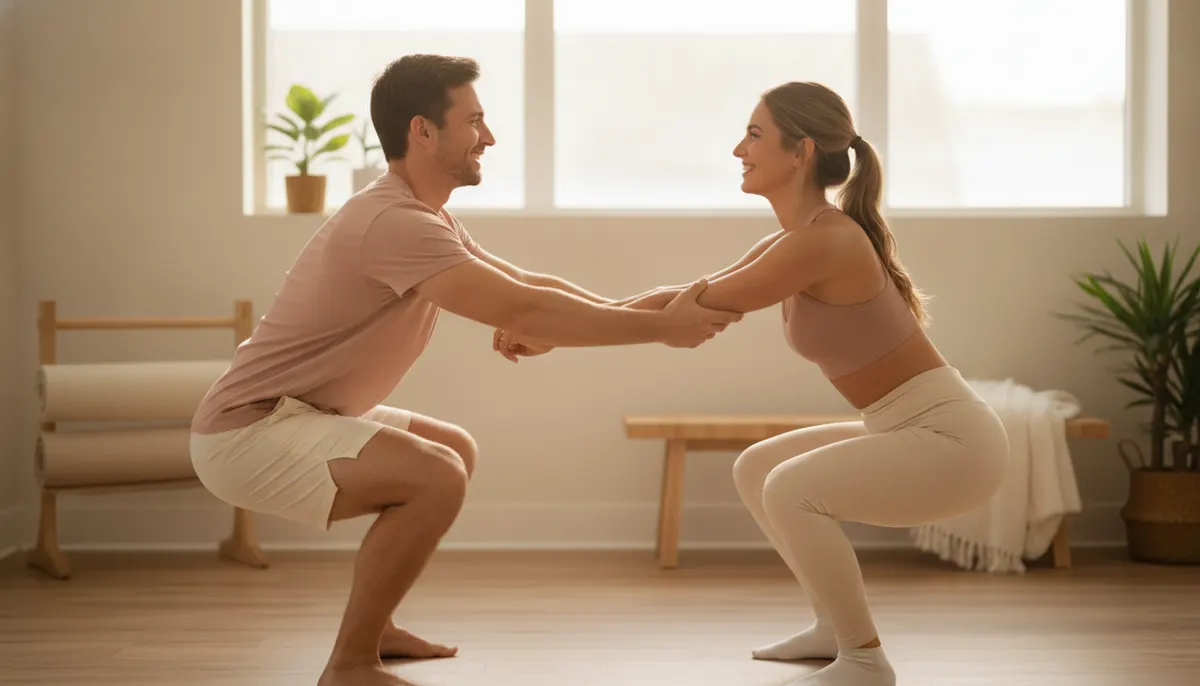
1. Facing partner squat, holding hands
The gateway partner squat. Stand facing each other with your toes about a foot apart, holding hands or wrists. Squat down together at the same speed, using a light pull on each other’s arms as a counterbalance, then stand up together.
The counterbalance lets both of you sit deeper and keep your chest up, which makes this a great way to learn depth. Count out loud for the first few reps (“down, two, three, up”) until you find a shared rhythm. Do not lean back and hang off each other; the pull should be light, a few pounds of tension at most.
Reps: 10 to 15, slow, with three seconds down and one second up.
2. Back-to-back squat
Stand back to back with your feet about hip width apart and your backs touching from the shoulder blades down. Walk your feet forward half a step so you can lean into each other. Squat down together, pressing gently into each other’s backs the whole way, until your thighs are about parallel. Stand up together.
The pressure between your backs is what makes this work; if one of you stops pressing, you both wobble. Keep talking: “pressing,” “going down,” “hold.” Link elbows for more stability, or keep your arms free for more challenge.
Reps: 8 to 12, or hold the bottom of the last rep for 10 to 20 seconds.
3. Assisted pistol squat, holding hands
This is the one people search for. A pistol squat is a single-leg squat with the other leg held out in front of you. On your own it demands serious strength, balance, and ankle mobility. With a partner holding your hands, it becomes something most people can practice on day one, which is why pistol squats for couples are so much friendlier than pistol squats alone.
Setup: stand facing each other, holding both hands. A wrist-to-wrist grip is more secure than palm-to-palm. The squatter lifts one leg out in front, straight or slightly bent. The assister stands with soft knees, feet staggered, core braced.
Movement: the squatter sits back and down on the standing leg, as low as they can control, using the partner’s arms for balance and a little lift. The assister keeps their arms firm and leans back just enough to counterbalance. The squatter drives through the whole foot to stand. Do all the reps on one leg, switch legs, then switch roles.
Cues for the squatter: knee tracks over the middle of the foot, heel stays down, and you only go as deep as you can without your lower back rounding hard. Use your partner for balance first and lift second. The goal over the coming weeks is to need less and less help.
Cues for the assister: this is a job, not a rest. Brace your core, keep your elbows soft but not loose, and never jerk your partner up. If they start to tip, say so and slow the rep down.
Reps: 5 to 8 per leg, or lower to a chair set behind the squatter until full depth arrives.
4. Medball pass squat
Stand facing each other about six feet apart, one of you holding a medicine ball (6 to 10 pounds is plenty) at chest height. Squat, stand, and push the ball to your partner from your chest as you reach the top. They catch it, squat, stand, and pass it back.
Catch with soft elbows and let the ball settle at your chest before you squat; never squat and catch at the same time. Keep the ball close to your body on the way down. For more work, both of you squat every time, whether or not you are holding the ball.
Reps: 10 to 15 passes each. No ball? A heavy book, a filled water jug, or a backpack with a towel inside all work.
5. Squat and high five
Stand facing each other at arm’s length. Squat down together, and at the top of each rep, high five with the right hand. Next rep, left hand. Then both hands.
This one sounds silly and is genuinely useful, because the high five forces you to finish each rep completely and stand tall before you reach. Keep it rhythmic. For a harder version, add a small hop at the top before the high five, landing softly with bent knees.
Reps: 12 to 20, or set a timer for 45 seconds.
6. Partner band squat
You need a long loop resistance band. Stand facing each other, each holding one end of the band at chest height, far enough apart that the band is taut when you are standing. Squat at the same time. The band pulls you toward each other, so your core and upper back have to work to keep you upright and the tension steady.
For a loaded version, one partner steps inside the band so it sits across their upper back, like a barbell, while the other holds the far end from behind and controls the resistance by stepping back or forward. Switch after each set.
Whoever controls the resistance moves slowly and announces changes (“adding a little”). Keep your shoulders down away from your ears, and do not let the band pull your chest forward.
Reps: 10 to 12 each, two to three sets.
7. Partner wall-sit squat hold
Sit into a wall squat side by side: backs flat against the wall, thighs parallel to the floor, knees stacked over ankles. Start a timer. To make it a partner exercise rather than two people suffering next to each other, pass a medicine ball, a water bottle, or a pillow back and forth, or hold hands and gently press into each other’s palms.
The no-wall version is the back-to-back squat from earlier, held at the bottom instead of repped out. It is harder, because you are each other’s wall.
Breathe; people hold their breath in wall sits and get lightheaded. Keep your heels down and your shoulders relaxed.
Time: 20 to 45 seconds. Add five seconds each session.
8. Jump squat relay
Mark two spots about fifteen feet apart (a yoga mat and a doormat, say). Partner A does five jump squats at spot one while Partner B holds a wall sit or a plank at spot two. Then you switch spots, tagging hands as you pass, and repeat for a set number of rounds.
For the jump squats: squat to about parallel, jump a few inches, and land quietly with bent knees, letting your hips absorb the landing. If jumping is not right for your knees or your downstairs neighbors, swap in fast bodyweight squats or a squat to calf raise instead.
Rounds: 4 to 6 each.
The 15-minute partner squat workout
Here is how I string these together when I have a quarter of an hour and two willing people. You need a timer.
Warm-up (3 minutes): march in place for 30 seconds, then do 10 bodyweight squats, 10 alternating reverse lunges, 10 hip circles in each direction, and 10 facing partner squats holding hands. If you have a few extra minutes, the 8-minute dynamic warm-up I use before every workout covers everything more thoroughly.
Main set (10 minutes): two rounds of the five exercises below, resting 30 seconds between exercises and one minute between rounds.
- Back-to-back squat: 10 reps
- Assisted pistol squat: 5 per leg for each partner
- Medball pass squat: 12 passes each
- Squat and high five: 45 seconds
- Partner wall-sit hold: 30 seconds
Finisher (2 minutes): jump squat relay, four rounds of five jump squats each, with the resting partner holding a plank.
Cool-down: walk around the room for a minute, then spend a few minutes on assisted partner stretches for your quads, hamstrings, and hips. It is my favorite way to end a session: the person who helped you squat also helps you unwind.
Do this two or three times a week with at least a day between sessions and you will feel the difference in your squats within a month.
Communication and safety for partner squats
Partner training is only better than solo training if you treat it like a team sport instead of a competition. A few rules I use with every couple I train:
- Agree on the words before you start. “Down,” “up,” “hold,” and “stop” cover almost everything. “Stop” means stop immediately, no questions, every time.
- Count your reps out loud, together. It sounds like kindergarten and it is the single best way to keep two people moving at the same tempo.
- Never jerk, yank, or surprise your partner, especially in the assisted pistol squat and the band variations. Smooth and boring is the goal.
- Pain is a stop sign, not a challenge. Muscle burn is fine; sharp pain in the knee, hip, or lower back is not, and if it keeps showing up, check with a doctor or physical therapist before you try again.
- Check your floor. Socks on hardwood and partner squats do not mix. Bare feet or shoes, on a mat or carpet.
- If either of you is pregnant, recovering from an injury, or has a history of knee or back problems, get a professional’s go-ahead first and skip the jumping and the loaded band version until you have it.
And one more: laugh when you fall over. You will, at least once, in the back-to-back squat. Squats for newlyweds could be its own category of marriage counseling, honestly, because falling over together and getting back up is decent practice.
Progressions when one partner is stronger
The most common complaint about couple squat exercises is mismatched fitness: one of you is bored while the other is dying. The fix is to change the dose for each person, not the exercise.
For the stronger partner:
- Slow the tempo. Three seconds down and a one-second pause at the bottom makes every variation harder without touching your partner’s rep count.
- Add a pulse at the bottom of each rep, or a hop at the top.
- Take the harder role. In the assisted pistol squat, try a fingertip assist instead of a full grip, or hold a light weight at your chest during the two-legged variations.
- Shorten your rest. Hold a plank or a wall sit while your partner recovers between exercises.
For the newer partner:
- Reduce the range. Squat to a chair or box set behind you, tap it, and stand.
- Cut reps rather than skipping exercises. Six good reps beat twelve rushed ones.
- Use the counterbalance. The hand-holding squat and the band squat let your partner take some of the load; that is the whole point of them.
- Skip the jump squats and do fast bodyweight squats instead.
These are the same levers I lay out in five ways to increase the intensity of any workout: tempo, rest, range of motion, load, and complexity. Turn them up for one person and down for the other, and the same workout works for both of you.
Where to go next
When you want a slower session together, ten beginner partner yoga poses use the same trust and communication skills with none of the burn, and they make a lovely rest-day activity. And if you want the whole circuit these squats came from, with the plank high fives and crunch passes included, go back to the original couples workout and run it start to finish.